For boards, CROs, CCOs, CAEs and CFOs who need four disciplines to work as one system: governance that clarifies accountability, risk that informs choices, compliance that stays current, and assurance that proves the system works.
Strong institutions need more than a GRC framework. They need governance that sets direction and accountability, risk intelligence that anticipates exposure, compliance that turns obligations into action, and assurance that independently validates performance.
Four Connected Capabilities
Turn oversight into an operating system.
Each capability has a distinct mandate. Together they create a connected operating model across the board, executive management and the three lines.
Governance
Board effectiveness, decision rights, delegation, policy governance, ethics and AI governance.
Connect boards, executive committees, business units and control functions through clear forums, mandates and reporting cadence.
Policy Governance
Policy lifecycle & attestation
Policy hierarchy, ownership, review cycles, approvals, exceptions, acknowledgements and evidence of compliance.
Ethics & Culture
Conduct, culture & speak-up governance
Governance of ethics, conflicts, conduct risk, whistleblowing, investigations and culture indicators.
AI Governance
Responsible AI operating model
AI inventory, ownership, policy, risk classification, lifecycle controls, oversight forums and monitoring aligned to responsible-AI principles.
Risk
Enterprise Risk Intelligence
Move from periodic risk registers to a decision-relevant view of exposures, dependencies, appetite and management action.
Enterprise Risk
ERM operating model
Risk policy, taxonomy, ownership, assessment methodology, treatment, KRIs, reporting and integration with planning and performance.
Risk Appetite
Risk appetite & limits
Board-level appetite statements translated into thresholds, indicators, limits, escalation and management action.
Operational Risk
Operational risk & loss-event management
Process and event risk, control self-assessment, incidents, root causes, action tracking and trend reporting.
Third-Party Risk
Third-party & outsourcing risk
Due diligence, risk tiering, criticality, concentration, contract obligations, ongoing monitoring and exit readiness.
Fraud Risk
Fraud risk management programme
Fraud-risk assessment, scenario library, preventive and detective controls, investigation governance and management reporting.
Emerging Risk
Emerging risk, scenarios & KRI intelligence
Horizon scanning, scenario analysis, indicators and executive sensing to identify material shifts before they become events.
Compliance
Obligations to Evidence
Turn regulatory obligations into owned requirements, mapped controls, evidence, monitoring and management action — across multiple jurisdictions and regulators.
Intake, impact assessment, ownership, implementation tracking and evidence of response to regulatory change.
Compliance Risk
Compliance risk assessment
Inherent exposure, control environment, residual risk, prioritisation and risk-based compliance planning.
Controls & Evidence
Requirement-to-control mapping
Map obligations to policies, controls, owners, testing, exceptions and reusable evidence across frameworks.
Monitoring & Testing
Compliance monitoring programme
Monitoring plans, control testing, attestations, issue identification, escalation and management reporting.
Breaches & Investigations
Breach, case & remediation governance
Record incidents and breaches, manage investigations, assign remediation and maintain closure evidence and audit trails.
Assurance
Independent Validation & Confidence
Modernise internal audit and controls assurance so boards receive clearer coverage, stronger evidence and faster remediation insight.
IA Digital Office
Internal Audit Digital Office
Audit universe, planning, execution, workpapers, findings, actions and Audit Committee dashboards in one connected model.
Risk-Based Planning
Dynamic audit planning
Risk assessment, assurance mapping, prioritisation and rolling plans that respond to changing exposure.
Delivery Models
Co-source, outsource & specialist audit
Flexible delivery capacity for core plans, technology, cyber, data, transformation and specialist assurance.
ICFR
ICFR & controls automation
Process documentation, control design, testing, evidence, deficiencies, certification and management reporting.
Continuous Assurance
Combined & continuous assurance
Connect assurance providers, control indicators, testing results, incidents and findings to identify gaps and duplication.
Quality & Remediation
QAIP, findings & closure discipline
Quality reviews, issue ageing, root-cause themes, closure evidence and independent validation of remediation.
Flagship Offers
Focused entry points for governance, risk and assurance leaders.
Start with a defined priority. Build the operating capability. Expand across the wider GRC estate only where value is proven.
GRC
GRC Transformation in 90 Days
Operating model, taxonomy, priority workflows, technology enablement, executive dashboards and a sequenced roadmap — designed to move GRC from fragmented registers to live operating capability.
Governance + ERM
Governance & ERM Operating Model
Governance structure, decision rights, risk appetite, ERM, KRIs, committee cadence and board visibility in one coherent management model.
Internal Audit
Internal Audit Digital Office
Audit universe, dynamic planning, execution, workpapers, findings, remediation and Audit Committee reporting supported by a connected digital operating model.
Controls
ICFR & Controls Automation
Process documentation, control design, testing, evidence, deficiencies, certification, remediation and management reporting with stronger traceability and ownership.
How We Deliver This Capability
One capability. Four ways to engage.
Govern can be delivered as a focused governance, risk, compliance or assurance engagement — or as a connected operating model supported by technology, recurring managed services and role-based capability development.
Consulting
Design the Governance & GRC Model
Strengthen board and committee governance, ERM, risk appetite, third-party risk, fraud risk, compliance operating models, internal audit, ICFR, controls assurance and AI governance. We design the model around accountability, decisions and regulatory reality.
Platform
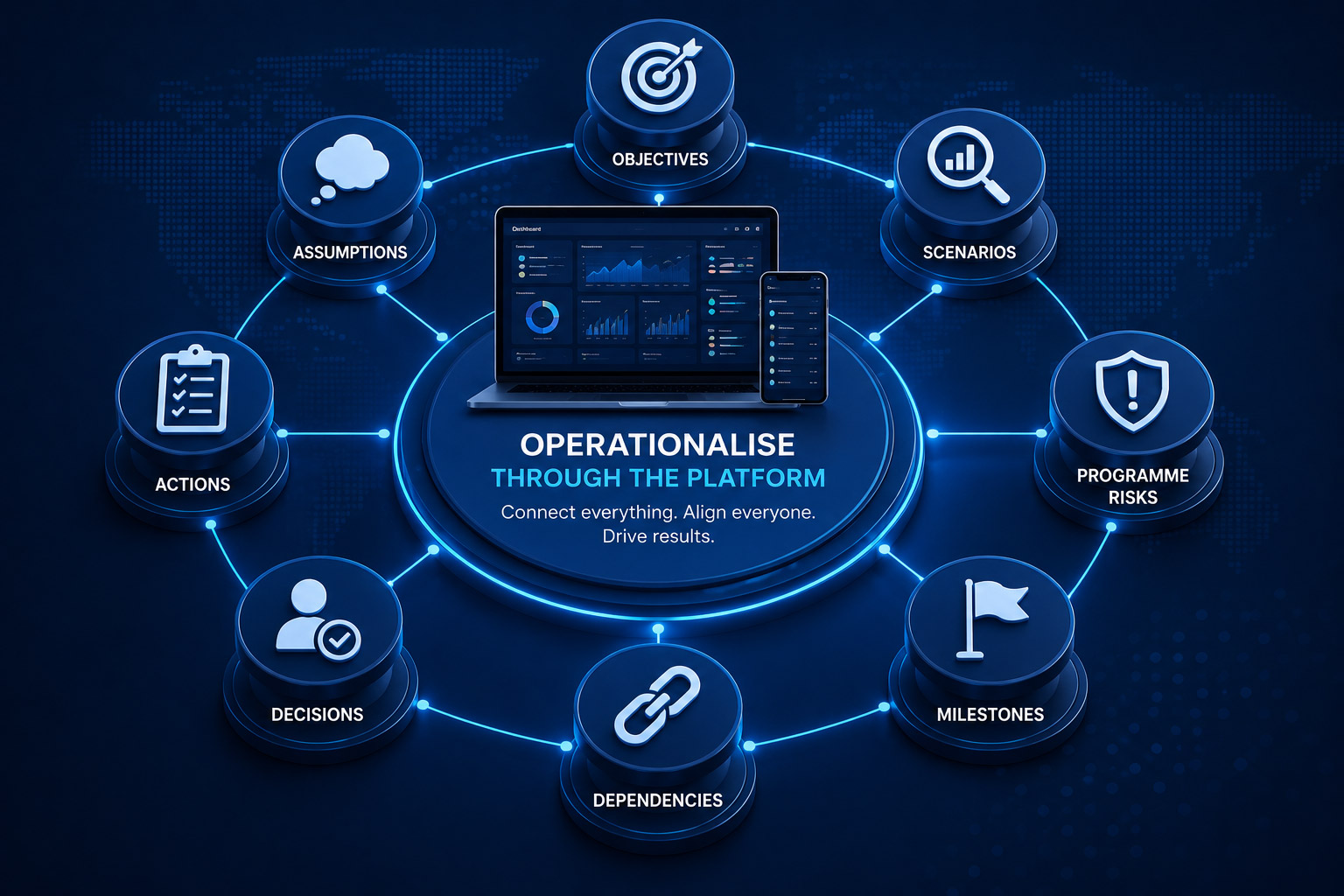
Operationalise through the platform
Bring policies, risks, KRIs, obligations, controls, assessments, evidence, audit work, findings and remediation into one connected environment with role-based workflows, dashboards and traceable accountability.
Managed Services
Run the GRC & Assurance Cadence
Use a Managed GRC Office, compliance monitoring, control testing, Internal Audit co-source or outsource support, remediation follow-up and virtual risk or compliance leadership to keep the model working between major projects.
Academy
Build Governance, Risk & Assurance Capability
Develop boards, risk owners, compliance teams, internal auditors and control owners through governance briefings, ERM academies, compliance training, controls and assurance pathways, fraud-risk awareness and responsible-AI governance programmes.
The capability is modular. A client can start with one priority — governance, ERM, compliance, Internal Audit or controls — and progressively connect the wider GRC estate as value is proven.
Explore the other practices
Practice 01
Transform
Strategy, uncertainty, programme assurance, decision intelligence, digital transformation and AI.
Practice 03
Protect
Cyber, privacy, technology risk, resilience, BCM, crisis and critical-service continuity.
Practice 04
Sustain
People and organisational performance, ESG, sustainability and long-term value.
Engage
Give the board a clearer line of sight and regulators stronger evidence.
Speak with the senior team about your governance and assurance agenda.